Monsoon Season, Car Under Water — When You Need Flooded Car Towing
Floods in Malaysia rarely give much notice. Two or three hours of heavy rain, drains that cannot swallow it fast enough, and the water is already in the car park before anyone has a chance to move a vehicle.
Three situations come up again and again. First, the basement car park of a condo or an office block — water runs down the ramp, pools on the lowest level, and cars sit submerged to window height while the owners are stuck upstairs. Second, a car parked beside the house in a low-lying area, with river water or drain overflow creeping up overnight. Third, a car that dies in the middle of the road because the driver tried to push through water that looked shallow and was not.
What decides the fate of the car is not how long it sat in the water. It is how high the water rose, and what you do after it drains away.
Water below the door sill is usually a small problem — brakes and wheel bearings need a check, and that is about it. Water above the door sill means the carpet, the floor insulation and the electronic modules under the seats are wet. Water at dashboard height means the fuse box, the main harness and the airbag system are involved.
And the one that matters most: water above the engine air intake means the engine has most likely swallowed some. That engine does not get started at all — not now, not tomorrow, not "just to test".
- Water below the door sill — the car may still be drivable, but check the brakes and wheel bearings first.
- Water above the door sill — carpet and the modules under the seats are wet, so do not drive it far.
- Water at dashboard height — the main electrical system is involved, so the car needs to be lifted, not driven.
- Water above the air intake — risk of water inside the cylinders, so do not turn the key even once.
- Car died by itself while going through water — assume water got into the engine until a workshop says otherwise.
Why A Flooded Car Cannot Be Towed The Normal Way — The Case For Flatbed Towing
Water cannot be compressed. That one line explains why a single turn of the key can destroy an engine that was otherwise still fine.
When water is sitting in the cylinder and you turn the key, the piston comes up and tries to compress a liquid that will not give at all. What gives instead is the connecting rod — it bends, or it snaps. That happens in under a second and it cannot be undone. Workshops call it hydrolock, and it is the main reason flood cars end up written off as beyond economical repair.
That is why the first thing we do on arrival is not start the car. A flooded vehicle is moved with the engine dead, and on a conventional petrol or diesel car the negative battery terminal comes off first so nothing shorts through wet wiring.
So why not a normal two-wheel tow? Because in a flood car, everything that spins is already contaminated. Muddy water gets into the wheel bearings, the gear oil and diff oil turn milky, and the brake pads may have rusted onto the discs after a night in the water.
Wheels turning in that condition do not just chew up the bearings — they push water and grit deeper into the driveline. All-wheel-drive cars are worse again, because one turning wheel means the entire driveline is moving.
Automatics add one more problem. The transmission oil pump only works while the engine is running. Tow an automatic with its driven wheels on the road and no engine running, and the gears are spinning with no lubrication reaching them.
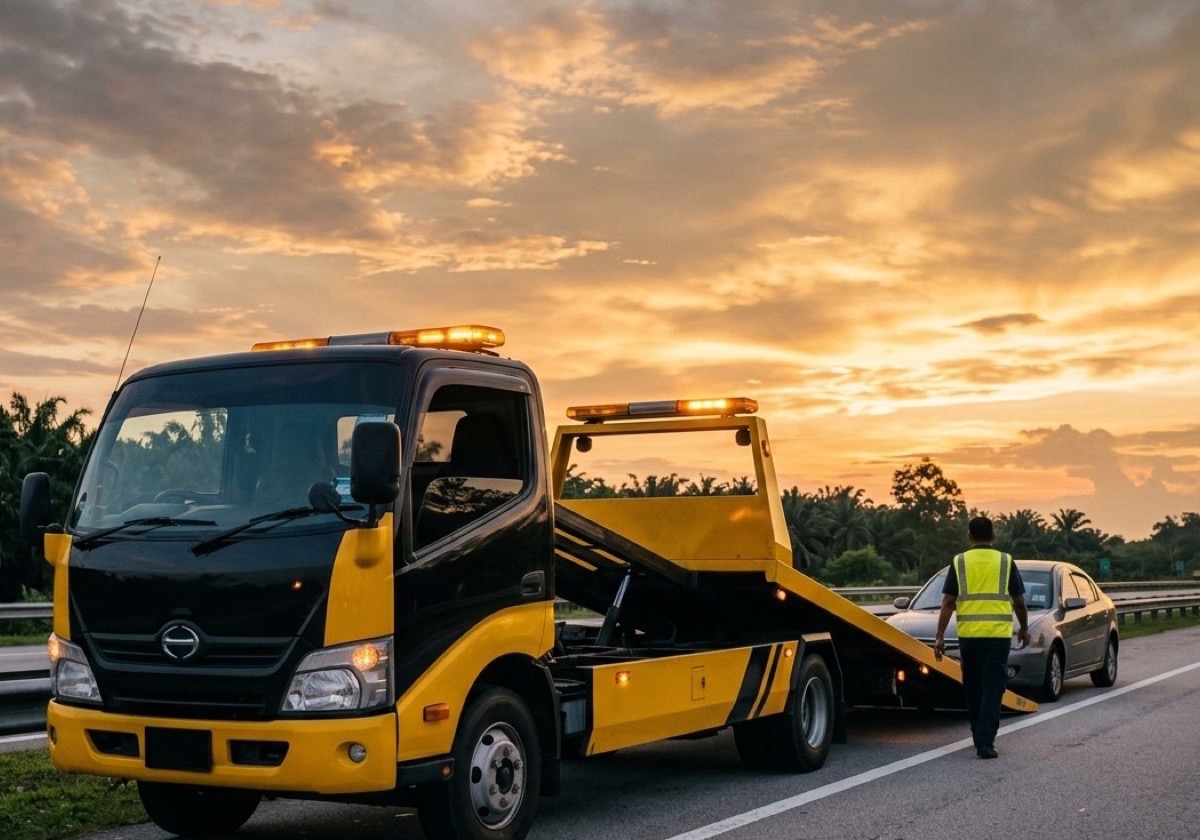
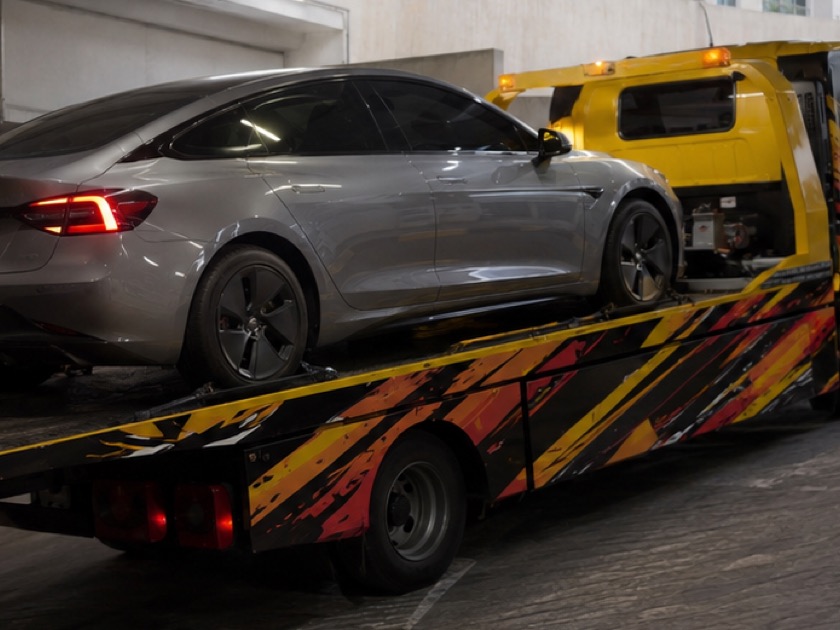
Which is why the answer here is a flatbed. All four wheels go up onto the deck, nothing rotates for the whole trip, and the water already inside the car is not forced anywhere more expensive. If you want the technical difference between the two carrying methods, we have broken it down point by point in a separate guide.
- Do not turn the key — not once, not even "just to test".
- Do not switch on the aircond, the radio or the power windows while the wiring is still wet.
- Do not open the bonnet and try to dry the plugs yourself if you are unsure how high the water went.
- Do not use a two-wheel tow with the other wheels on the road — go flatbed.
- Do not push the car out of the water if the brakes may have seized.
Winching Out Of Mud And Basement Car Parks — Lori Towing Recovery Work
Flood cars are hardly ever somewhere convenient. They are on the bottom level of a multi-storey car park, on soft ground behind the house, or stranded on a muddy road shoulder after the water has gone down.
First rule: we do not go into water that is still moving. Moving water hides potholes, open drain covers and cables that may still be live. Recovery only starts once the level has dropped and the area is confirmed safe to enter.
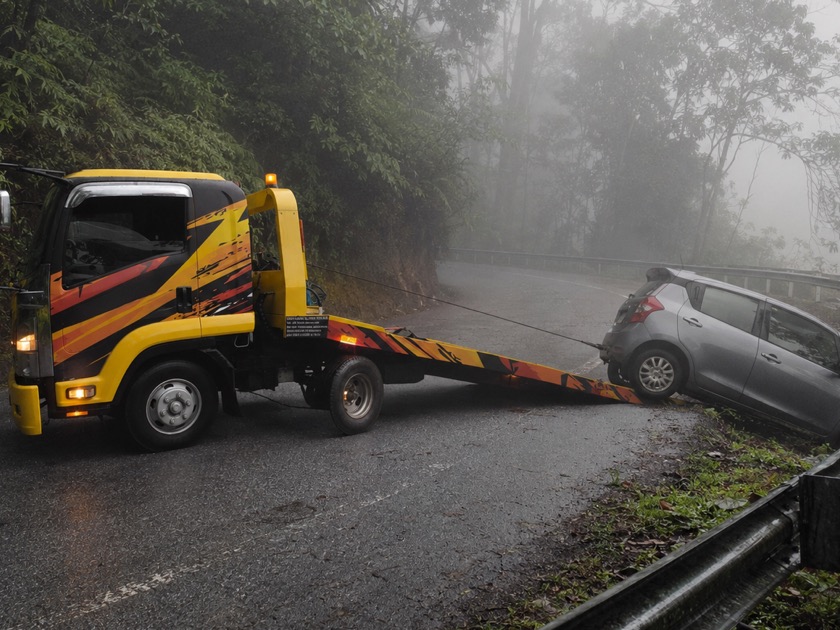
For basement car parks, the obstacle is usually not the weight of the car — it is space. Ceiling height and ramp angle normally will not let a flatbed drive down there. The correct method is to winch the car up the ramp to street level using a recovery strap off a proper chassis point, then load it onto the flatbed outside.
If the wheels are fully locked — brakes seized, or the steering locked because there is no power — the car goes onto skates or wheel dollies so it can be slid without forcing anything to rotate.
Straps go onto recovery points designed to take a pulling load, not onto suspension arms or the anti-roll bar. This is not fussiness: pulling from the wrong point bends steering and suspension components, and turns one recovery job into a second repair bill.
A car sitting on soft mud needs a slow, straight pull, sometimes with timber blocks under the wheels. Yanking it in mud only digs it in deeper.
Winching work varies a lot with the situation, so we need to see the real thing before quoting. WhatsApp Abang Tow, send your live location and a photo or two of the car and the water line on the bodywork — the price is confirmed in chat first, then the unit rolls. Standby 24 hours, across Peninsular Malaysia, including the east coast areas that cop the worst of the monsoon.
- Access — car park ramp, narrow lane, soft ground or road shoulder.
- Water level, and whether the area is safe to enter yet.
- Whether the wheels still roll freely or have locked up completely.
- Winching distance from where the car sits to where the lori can stop.
- Final destination — a workshop in the same state, or an interstate run.
Flooded EVs And Hybrids — Careful Handling Before The Towing Service Arrives
A flooded EV or hybrid is not simply a broken-car job. It is a safety job, and it is handled in a completely different way.
The high-voltage battery pack sits low, usually under the floor — the first part of the car to go under. Salt water, or floodwater mixed with runoff, makes it worse because it conducts.
What most people do not realise: a high-voltage pack that has been submerged does not necessarily fail straight away. It can go days later, after the car has looked "fine" the whole time. That is why a flooded EV should not be parked tight against other vehicles, inside a closed garage, or up against the wall of a house.
A few things we ask EV and hybrid owners to stick to while waiting: do not get back into the car, do not touch any orange cable, do not attempt to charge it, and do not power up the system just to see what percentage the battery is at.
On the transport side, an EV only travels on a full flatbed. The electric motor generates current when the wheels turn — towing an EV with wheels on the road means you are forcing an already wet system to make power. That is a risk nobody should take.
Tell us in the first message that the car is an EV or a hybrid, and give us the make and model. The unit we send, the way it is strapped down, and where the car is parked after delivery all depend on that.
- Do not get back into the car or press the start button.
- Do not touch orange cables or try to remove high-voltage components yourself.
- Do not charge it, even if the display looks normal.
- Move nearby parked cars away if it is safe to do so.
- Tell the towing operator it is an EV or hybrid before a unit is dispatched.
Where The Flood Car Goes After 24/7 Towing — Own Workshop Or Interstate Delivery
This question usually gets asked too late, when it should be settled before the car goes up on the truck. The destination sets the price, and changing it halfway changes the cost.
If you intend to make a claim, the car normally has to go to a panel workshop so the assessor can inspect it in its original state. Avoid cleaning the interior or pulling the carpet out before the inspection — the water line is part of the evidence.
If you are choosing your own workshop, make sure it actually does flood work. This is not an oil change: the carpet and insulation have to come out completely, the space under the seats has to be dried, wiring connectors have to be checked one by one, and the engine oil, gear oil and diff oil all have to be checked for water.
One practical thing: pick somewhere sheltered and ventilated, not a sealed container. A flood car locked up in a hot, closed space grows mould fast, and that smell is very hard to remove once it is in the insulation.
If the specialist workshop you want is in another state, that is an interstate job — routine for us, it just has to be mentioned early so the quote is worked out correctly in one go.
Pricing goes by distance: deliveries under 50 km start from RM230, under 100 km from RM400, and under 150 km from RM450. Winching out of a basement car park or a muddy area is raised upfront so the quote you get is the final one — the price confirmed in chat is the price you pay.
- Decide the destination before the car goes onto the truck, not after.
- Keep photos of the water line on the body and inside the cabin before anything is cleaned.
- Pick somewhere sheltered and ventilated so the interior does not grow mould.
- Say so if the destination crosses a state line — that is an interstate job.
- Raise the winching work early so the price does not change on site.
Car Owner's Checklist Before The Tow Truck Arrives
While you wait, there are a few things you can get out of the way. All of them are free, all of them save time on site, and some of them save you money later.
Work through them in order, and only if the area is genuinely safe. If the water is still moving, or you are unsure about electrical cables around you, stop at step one and wait.
Keep the answers together in one message. Something like "water up to below the window, automatic, parked on level B2, wheels will not turn" is far more useful than "my car kena flood" — the right unit can be sent straight away, and the quote is accurate from the first message.
- Step 1 — Make sure the area is safe. Do not walk through moving water, and do not enter a car park level that still has water in it.
- Step 2 — Do not turn the key, and do not switch on any electrical system in the car.
- Step 3 — Take photos: the water line on the bodywork, the interior, the odometer reading, and the surroundings.
- Step 4 — Note the highest water level. Use the dirt mark on the door or on the seat as your reference.
- Step 5 — Take out documents, personal items, the Touch ’n Go card and anything valuable.
- Step 6 — Have the car details ready: make, model, year, automatic or manual, petrol, diesel, hybrid or EV.
- Step 7 — Check whether the wheels still turn, and whether the steering is locked.
- Step 8 — Decide the destination: panel workshop, your own workshop, or home first.
- Step 9 — Check the access for the truck: ceiling height, lane width, ground condition, and where the truck can stop.
- Step 10 — Send your live location, the photos and all of the above in one WhatsApp message.
Save An Emergency Roadside Assistance Number Before The Next Monsoon
A flooded car is not something you can plan for. It happens in the middle of the night, in rain that will not let up, and usually in an area where even the road out is already under water.
The difference between a contained case and an expensive one comes down to two things: you did not start the engine, and you called the right unit from the beginning.
If your car is under water right now, or the water has only just gone down — do not turn the key. WhatsApp Abang Tow, send your live location, photos of the car and the vehicle type. The price is confirmed in chat first, then the unit rolls, and the car goes to the workshop you choose, not the one we choose. Standby 24 hours across Peninsular Malaysia — car towing, motorcycle towing and lorry towing, all 13 states.