Flatbed Vs Wheel-Lift — The Basic Difference Between Two Types Of Tow Truck
Two names, one question: does your vehicle ride fully on the deck, or does it hang from one end?
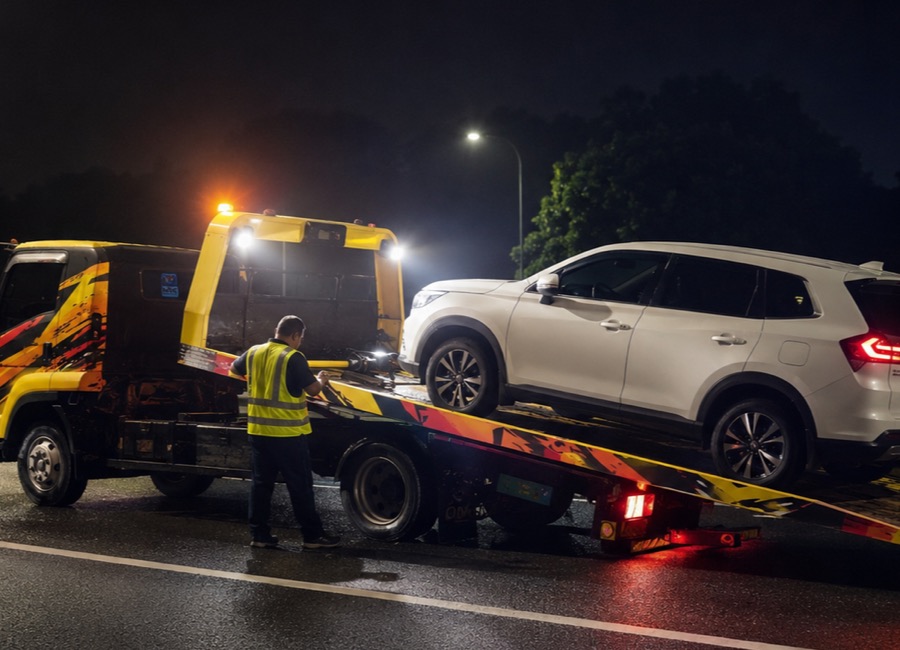
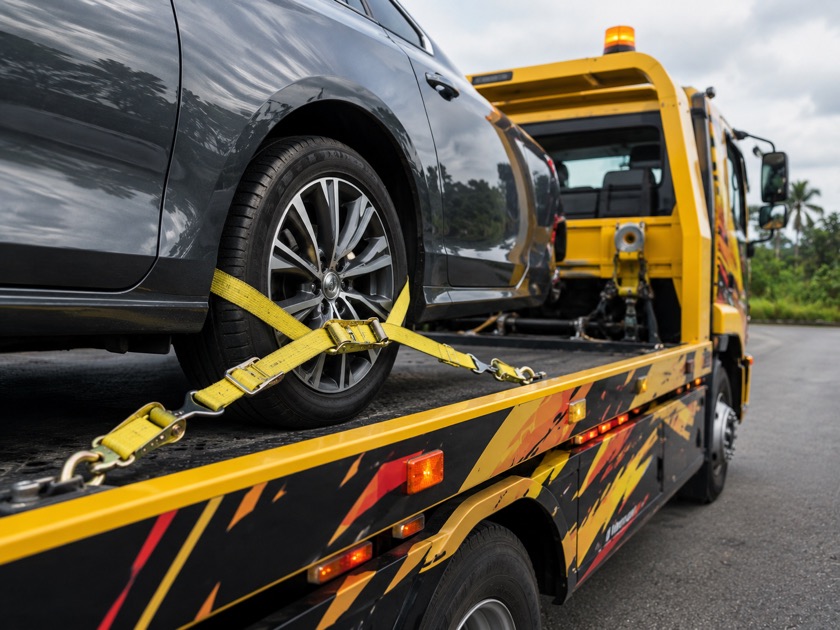
A flatbed is a lori with a flat deck that tilts back and turns into a ramp. The whole car is pulled up onto that deck and strapped down at four corners. For the entire trip, not a single tyre turns.
A wheel-lift uses a steel yoke that slides under one pair of tyres and lifts that end of the car. The remaining two tyres keep rolling along the road all the way to the destination.
That is the only real difference. Everything else — the risk to the transmission, the space the unit needs, how long loading takes, whether it suits a long run — comes out of that one point. If words like winching, dolly and rigging are still unfamiliar, we have a towing glossary in plain English you can read first.
Flatbed Vs Wheel-Lift Comparison Table For Car Towing Jobs
Read it line by line against the state your car is in right now. If most lines lean one way, that is your answer.
- Vehicle suitability — Flatbed: almost anything, from a low sports car to a 4WD, a small van or a big motorcycle. · Wheel-lift: ordinary cars whose wheels still turn freely.
- Risk to the transmission — Flatbed: none, because no wheel turns at all. · Wheel-lift: real, if the drive wheels are the ones left on the road.
- Ground clearance — Flatbed: a low bumper can catch the ramp angle, so extension ramps or boards are needed. · Wheel-lift: the underside can scrape while the yoke slides in if the car sits too low.
- Long distance and interstate towing — Flatbed: the right call, since tyres and wheel bearings do not clock the mileage. · Wheel-lift: the further you go, the more turns those two rolling tyres take.
- Tight access — Flatbed: needs clear straight space behind the truck for the deck to tilt and the car to climb. · Wheel-lift: shorter and lower unit, gets into basements and narrow lanes.
- Loading time — Flatbed: longer, because the car has to be winched up and strapped at four corners. · Wheel-lift: faster — slide in, lift, lock, move.
- Accident vehicles — Flatbed: fine, even with bent wheels or broken suspension. · Wheel-lift: needs dollies if the wheels will not turn.
- EVs and hybrids — Flatbed: the only method we recommend. · Wheel-lift: not advised, unless dollies go under the wheels left on the road.
Advantages Of A Flatbed Tow Truck For Car And Motorcycle Towing
A flatbed is the safe default if you would rather not think too hard about it. Car goes up, car comes down, end of story.
It is not the answer for every location, though. The strengths first:
- All four tyres fully off the ground — the gearbox, the electric motor, the driveline and the wheel bearings do no work for the whole trip.
- Safe for vehicles that must not be dragged: EVs, hybrids, automatics that will not go into neutral, and all-wheel drive.
- Handles badly damaged vehicles — bent wheels, broken suspension, or a car that will not roll at all.
- The most stable option for long distance and interstate towing, since nothing is rotating along the way.
- Awkward loads still go up: superbikes, ATVs, small machinery, and vehicles missing a wheel entirely.
When Flatbed Towing Becomes Awkward On A Car Towing Job
The downsides are all about size and space, not about vehicle safety.
A flatbed is a long unit. To load a car, the truck needs clear straight space behind it so the deck can tilt down and the car has a run-up. On an open roadside, that is nothing. In a dead-end lane behind a row of shops, or in a tight car park, it becomes work.
Low ceilings are an absolute stop. Multi-storey car parks and condominium basements usually cannot take the height of a flatbed lori — not because the driver will not go in, but because the truck physically does not fit.
Loading also takes longer. The car has to be winched up, positioned properly on the deck, and strapped down at four corners with ratchet straps. If you are standing on a busy highway shoulder, those extra minutes are felt.
For a very low car, the ramp angle can catch the lip of the bumper. That is solved with extension ramps or lift boards — but you have to say so early, so the driver brings that gear along.
Wheel-Lift Advantages In Everyday Car Towing Service Work
A wheel-lift is not the lesser tool — it is the tool for a different job.
Its main strengths are access and speed. The unit is shorter and lower, so it gets into places a flatbed simply cannot reach, and this is where it earns its keep:
- Gets into low-ceiling basements, multi-storey car parks and narrow city lanes.
- Loads faster — no winching up a deck, so you spend less time exposed at the edge of a busy road.
- Suits a car wedged between two others, or one blocking a driveway that has to be shifted straight away.
- Enough and sensible for short runs: home to workshop, workshop to workshop, within the same area.
- Can be paired with dollies — a small pair of wheels under the locked tyres — so even a car whose wheels will not turn can still be moved.
Wheel-Lift Risks Most People Miss Before Calling A Tow Truck
There is only one real drawback, but it is a big one: two tyres stay on the road, turning, for the whole journey.
If those two are the drive wheels, they force the gearbox and driveline to spin with the engine off. On some automatics, that means the transmission fluid is not circulating the way it should. The damage does not show up on the spot — it shows up later, as a bill that looks completely unrelated to the night you called for towing.
For EVs and hybrids, the problem is different again. Rolling wheels can spin the electric motor and push current back into the system. Which is why the answer is simple: an EV goes on a flatbed, full stop.
Low bumpers need care too. The wheel-lift yoke has to slide under the car, and if the clearance is very tight, the apron or the side skirt can catch.
The summary for this section: a wheel-lift is safe when the wheels left on the road roll freely, and when the trip is short. Outside those two conditions, a flatbed is the calmer choice. This is also not a roadside assistance question — nobody jump-starts their way out of a locked gearbox.
Not sure which category your car falls into? Do not guess. Send the model, the transmission type and the condition of the wheels in one WhatsApp message — we match the right unit, and the price is confirmed before anything rolls. Standby 24 hours.
When Flatbed Towing Is Compulsory: EVs, Accident Cars And Interstate Towing
There is a short list of situations where we simply will not offer the other option. If your car falls into any of them, a flatbed is the answer.
- EVs and hybrids — the electric motor must not be left spinning for the length of the trip.
- Automatics that will not go into neutral, or a gearbox that locked up after the car died.
- All-wheel drive and 4WD — all four wheels are connected, so no end of the car is truly free.
- Accident vehicles — bent wheels, broken suspension, a twisted chassis, or a car that will not roll straight at all.
- Luxury cars, sports coupes and low cars whose paint and underbody panels are expensive to put right.
- Long distance and interstate work between states — no reason to make two tyres clock hundreds of kilometres for nothing.
- Flood-hit cars that have not been inspected — do not start them, and do not move them on their own wheels.
When Wheel-Lift Is Enough For Short-Distance Car Towing
Now the other side. Not every job needs a flatbed, and forcing one into a place it does not fit only slows you down.
A wheel-lift is enough when the wheels left on the road can spin freely — a manual that goes into neutral, for example, or a car driven from one end where that driven end is the one being lifted.
It is also the practical choice when the location is the problem, not the vehicle. Low car park roofs, office basements, tight entry ramps, a car boxed in between two others — all wheel-lift work.
Short distance is the second condition. Moving a car from home to a workshop in the same town, or pulling it out of a basement to street level so a flatbed can take over outside — that is exactly what a wheel-lift does every day, including in the dense areas listed on our Kuala Lumpur towing coverage page.
And if the wheels are locked but the space is still tight, the middle path is a wheel-lift with dollies. Nothing on the car is turning, but the unit is still small enough to get out of there.
Flatbed Vs Wheel-Lift Towing Price — What A Towing Service Actually Charges For
This is where most people get it wrong. Many assume a wheel-lift is automatically cheaper, so they choose by wallet instead of by vehicle.
Our car towing price is worked out by distance: from RM230 for deliveries under 50 km, from RM400 under 100 km, and from RM450 under 150 km. Heavy vehicle work is classed by tonnage instead — 5 ton, 10 ton and 15 ton.
Which means flatbed or wheel-lift is not a wallet decision. It is a technical one, and we make it from the information you send.
If the job needs extras — winching out of a drain, or dollies for locked wheels — that is stated upfront in the quote, not sprung on you at the end once the work is done. The price you confirm is the price you pay.
Verdict By Situation — Checklist Before You WhatsApp A 24 Hour Towing Service
The three-line version, if you would rather not read it all again:
EV, hybrid, an automatic that will not go into neutral, AWD, accident car, low car, or an interstate run — flatbed. A manual with free-rolling wheels, a short distance, or a low-ceiling location — a wheel-lift is enough. Locked wheels but tight space — wheel-lift with dollies.
And if you genuinely cannot tell: pick the flatbed. Getting the flatbed choice wrong costs you a bit of extra time. Getting the wheel-lift choice wrong can cost you a gearbox.
You do not actually have to decide on your own. Send these six details in one message and let us match the unit:
- Live location from WhatsApp — not just the name of the place.
- Car model, and whether it is automatic, manual, hybrid or EV.
- Wheel condition: still turning, locked, or a tyre off completely.
- Whether the car will go into neutral.
- Destination — which workshop, which home address, or which state if it is an interstate job.
- Obstacles at the location: low ceiling, a slope, a drain, a busy highway shoulder or an R&R, or limited space behind the car.
Still Unsure? WhatsApp Us — 24 Hour Towing Service Across Peninsular Malaysia
Deck type is not a question you should have to answer at the roadside at two in the morning.
Send the six details above in one WhatsApp message to the Abang Tow 24 hour towing service. We decide flatbed or wheel-lift, and the price is confirmed in black and white before the unit moves.
If your vehicle is an EV or a high-value car, read how we tow luxury cars and EVs first — so you know what should be happening before the unit even arrives.
Standby 24 hours, seven days, across Peninsular Malaysia — car towing, motorcycle towing and lorry towing. Send your location. Confirm the price. The unit rolls.