Loaded Lori Down on a Main Road — When Lorry Towing Turns Into Risky Work
Your box lori loses power in the middle of a main road on the morning run. Or the rear axle starts making a noise you have never heard before just after pulling out of the industrial estate, and the lori stops half a lane short of the loading bay. Fully loaded, one driver on his own, and the horns behind him start up.
This is not the same job as a car breaking down. Not because the damage is worse, but because four things are moving at once: the driver’s safety, a load that belongs to somebody, a delivery schedule that has already slipped, and a large vehicle sitting in everybody else’s way. Inside an industrial area, one lori stuck in a narrow lane can hold up every other trailer for the rest of the day.
So the order of work has to be clear: make the people safe, make the site safe, collect the technical details, then make the call. Reverse that order and the wrong unit gets sent, and you end up waiting twice. This is the procedure for the driver before the tow truck arrives.
- Hazards on, and the warning triangle goes much further back than usual — drivers coming up behind a heavy vehicle need more distance to react.
- Park brake on, in gear, wheel chocks down if you carry them. On a loaded lori sitting on any kind of slope, chocks are more trustworthy than the brake alone.
- If the brakes have locked because the air system is leaking, do not try to release them yourself. Tell us early — the unit sent out has to bring the right equipment.
- Everybody out of the traffic lane, standing on open ground, not between the lori and the vehicles going past.
- Photograph the plate number, the body of the lori, where it is sitting on the road, and the space around it — the photo of the space is what tells us whether a big unit can get in.
- Inform the supervisor first, so the driver on site already has cost approval in hand.
- Do not pull it with another company lori or a rope. The wrong hitch point can bend the chassis, and pulling a vehicle that has no brakes is never worth it.
Tonnage and Axle Configuration Decide Which Lorry Towing Unit Is Sent
The first question we ask on a commercial case is not the location — it is the weight and the shape of the vehicle. The unit is picked on actual weight including the load, not on how big the lori looks in the photo. The same model can be two completely different jobs: empty, it is a mid-size unit’s work; loaded, it moves up into a heavier class.
Axle configuration decides how it can be pulled. A rear-wheel-drive lori lifted from the front means the drive axle is still on the road and turning for the whole journey — while gearbox lubrication depends on an engine that is running. In that case the propeller shaft comes out, the vehicle is lifted from the rear instead, or the driven wheels go up on dollies. That gets planned before the unit leaves, not sorted out at the roadside.
Air brakes are the next layer. On most heavy vehicles the park brake is held by a spring and released by air pressure — so when the system loses air, the wheels lock automatically. That is a safety feature, not extra damage, but the lori cannot be pushed or pulled until the brakes have been released properly.
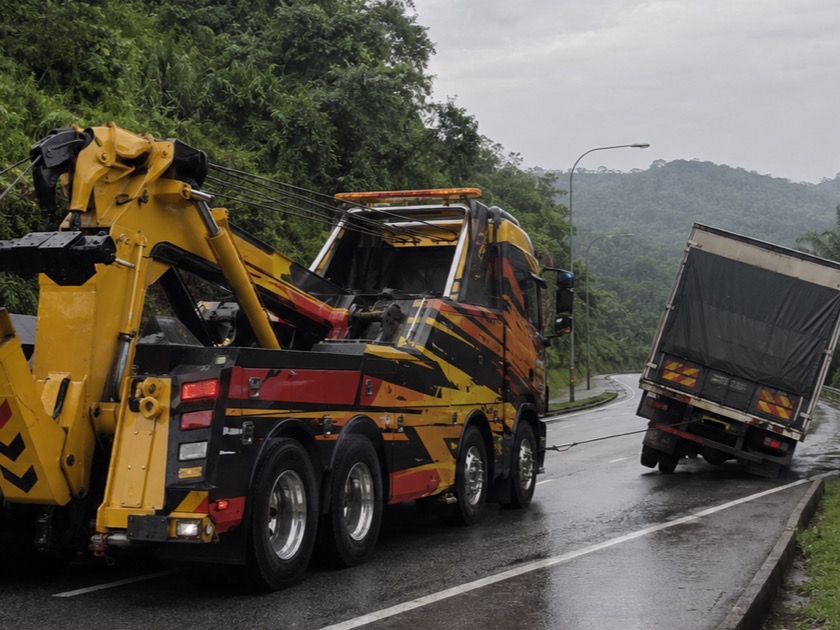
Body type then changes the hitch points and the rigging method: box, tipper, tanker, crane lori and prime mover with trailer are all different structures. A prime mover that goes down while still coupled to a trailer is two jobs — uncouple the trailer first, then deal with each one.
The Load on the Lori — Transfer It First, or Take It Along With the Tow Truck
A load changes two things at the same time: the total weight, and how that weight sits across the axles. Both matter for a safe pull.
The load has to come off first when the total weight goes past the unit’s capacity or a road weight limit, when it can shift while the vehicle is being lifted, when it is perishable like frozen goods, or when the trip is a long run across state lines. It can travel with the vehicle when it is properly secured, the weight is inside the unit’s limit, and the destination is close.
If the load has to be transferred, that is not something done on the spot — it needs a replacement vehicle, manpower or a forklift, and safe space to unload. Sometimes the lori has to be towed to open ground nearby first, because unloading at the edge of a busy road is more dangerous than the original problem. Hazardous goods or controlled materials have their own procedure — mention it in the first message.
Not sure whether the load should be transferred or travel with the vehicle? Send photos of the load and a rough weight over WhatsApp — we assess it, recommend the safer option, and confirm the full price before the unit moves.
- Rough weight of the load, and whether the lori is fully or only partly loaded.
- Type of load: bulk, palletised, frozen, liquid, machinery, or controlled goods.
- How the load is secured — ratchet straps, netting, or not secured at all.
- Whether there is a replacement vehicle, a forklift or manpower to receive and unload it.
Winching Off a Soft Shoulder or Out of a Site — Roadside Assistance for a Lori
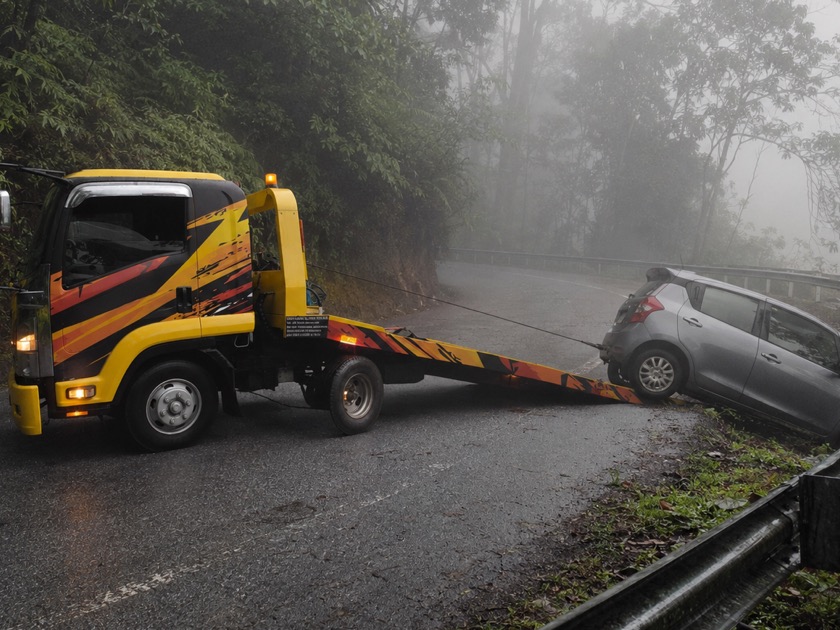
Not every lori case is a breakdown. A lot of commercial calls are actually stuck-vehicle cases: the left wheels drop off a soft shoulder after rain, the lori bogs down in soft ground on a construction site, or the rear axle slips into a shallow drain while reversing.
The main job here is not the run to the workshop — it is getting the vehicle out of where it is sitting first. That is winching, and it turns on three things: the pulling angle, the anchor point, and the ground condition.
The anchor point has to be a chassis structure built to take pulling force. Hooking a cable onto a bumper, a body bracket or a side step does not just fail — it wrecks the part that was made to take the load. If the angle is off, a snatch block is used to redirect the force so the vehicle comes out along its own tracks instead of being dragged sideways.
Ground condition decides whether one unit is enough or two are needed — soft ground demands far more force than a hard surface. While winching is under way the cable is under high tension; if it snaps, it whips. Everyone not involved stays well clear of the cable zone.
- Ground condition: hard tarmac, gravel, soft red earth, or mud.
- How much the site slopes, and how deep the vehicle has sunk.
- Room for the unit to stand and turn, plus the distance from the main road to the lori.
- Height restrictions: warehouse doors, loading bay canopies, or overhead cables.
- Who the site PIC is, and whether an entry pass or a safety briefing is needed.
- Whether the lori can move under its own power once it is out, or has to go straight to the workshop.
Lorry Towing Classes — 5, 10 and 15 Tonne, Plus Where Flatbed Towing Fits
Unit classes are set by tonnage because lifting capacity and the systems that have to be supported change at every step. Here is the short version.
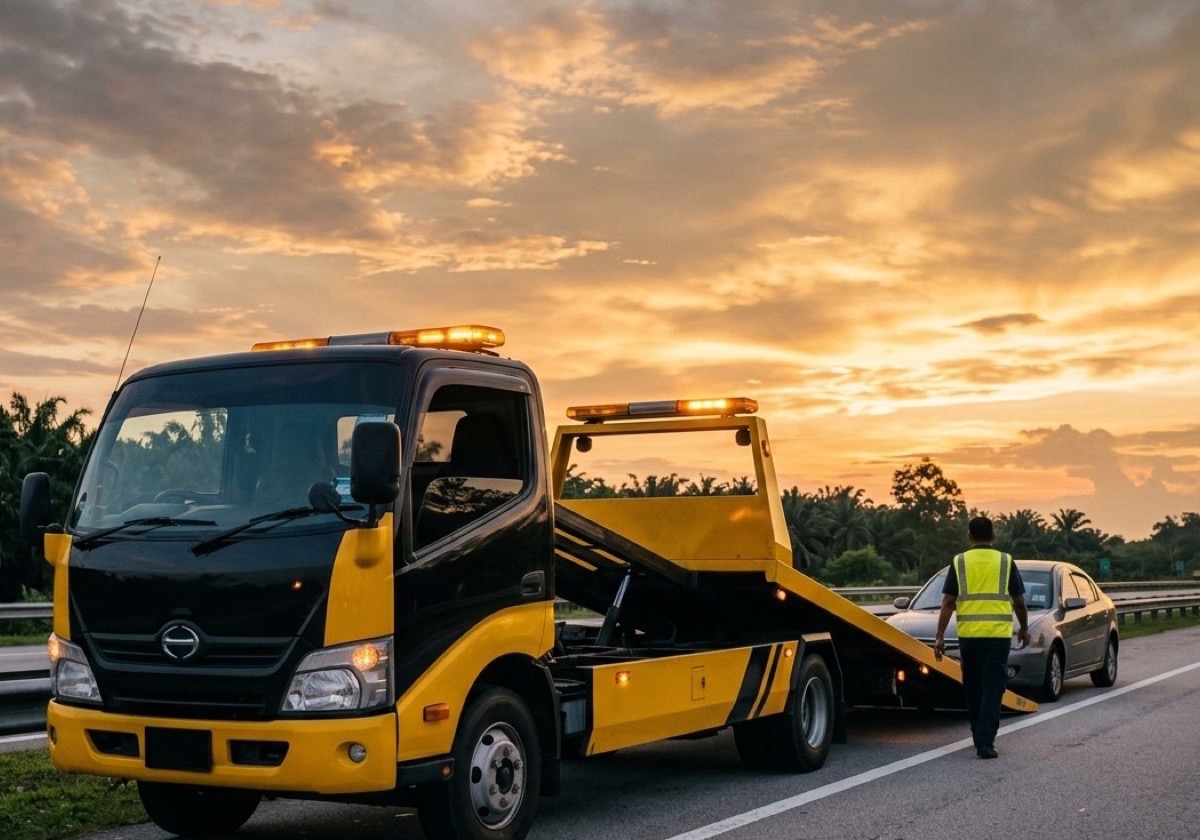
The 5 tonne class covers light rigid lories — city distribution vehicles, small box lories, large commercial vans. These are usually handled with a light unit or a flatbed, and flatbed towing becomes the choice when the vehicle cannot roll at all.
The 10 tonne class covers medium rigids — six or ten wheelers, box or tipper bodies. At this level the air brake system and the axle weights already call for a proper underlift, not just a front hitch.
The 15 tonne class covers heavy vehicles: large rigids, prime movers and buses. The rigging is more involved, and sometimes the trailer has to be uncoupled first. Outside these three classes there are machinery cases — an excavator or a roller carried on a lowloader. That is transport work, not towing.
Lorry towing prices are worked out on the tonnage class, the distance to the destination, and the site condition — a winching case is not the same as a straight pull off level road. The full price is confirmed over WhatsApp before the unit moves, and the price confirmed is the price you pay. If your fleet also runs company cars, car towing tiers are easier to estimate: from RM230 for under 50 km, from RM400 for under 100 km, and from RM450 for under 150 km — all starting prices.
Fleet and Driver Coordination — What Our Towing Service Asks on a Commercial Case
Commercial cases carry a problem private cases do not: two parties are involved. The driver is at the location but cannot approve the cost. The office can approve the cost but cannot see the site. When both talk to us separately, the details contradict each other and time gets burned. The efficient way is one line only.
The list below is what we ask for on fleet cases. Keep it saved in every driver’s phone notes.
One thing that gets forgotten until the unit has already arrived: who is receiving the vehicle at the other end. A workshop that is closed, or a depot with nobody on duty, means the vehicle cannot be handed over. And if the vehicle has to go back across state lines to the main depot, say so early — interstate towing is handled far more cleanly as one run than split into two separate tows.
- Company name, the driver’s name on site, and who is authorised to approve the cost.
- Plate number, make and model, and the tonnage or weight class.
- Body type: box, tipper, tanker, prime mover with or without trailer, or bus.
- The symptoms: engine dead, gearbox will not go into gear, brakes locked, blown tyre, or an accident.
- WhatsApp live location, and whether the lori is on a public road, inside a gated area, or on a site that needs an entry pass.
- Condition of the load and whether it can be transferred.
- Exact destination: workshop or depot name, address, and operating hours.
- Name and number of the person receiving the vehicle at the destination.
Lori Down Right Now? 24 Hour Towing on Standby Across the Peninsula
If your lori is sitting out there while you read this, open WhatsApp and send four things: live location, plate number with tonnage, what the symptoms are, and the state of the load. That is enough for us to match a unit and reply with a price.
Abang Tow is on standby 24 hours across the 13 states of Peninsular Malaysia — nights, weekends and public holidays included, because commercial vehicles do not break down to office hours. Car towing, motorcycle towing, lorry towing and buses, one number.
For cases in industrial corridors like Nilai and Senawang, check the state page for that area; if it happened on a highway, the guide to a car breaking down on the highway sets out the order of calls inside a tolled stretch, and that order applies to heavy vehicles too. And if you are reading this calmly at the office: circulate the checklist of details to have ready before calling towing to every driver now.