Why Catching the Early Signs Beats Calling an Emergency Tow Truck
Most of the cars we lift late at night did not fail out of nowhere. Ask the driver a couple of questions and the answer is almost always the same: that light came on last week, that noise started last month, but the car was still moving so it got left alone.
The problem is that car faults rarely stay in one place. A weak alternator drains the battery. An overheating engine can warp the cylinder head. Worn brake pads eat into the disc. The bill multiplies, and the car picks the worst possible spot to die — middle of traffic, on a bridge, or on an exit ramp with no shoulder.
Catch the signs early and you decide when the car goes in and which workshop it goes to. Miss them and the road decides for you. These are the eight signs that show up most often before a car is properly stranded:
- Battery or charging system warning light coming on while you are driving
- Engine temperature light in the red, or the needle climbing past the middle
- Oil pressure light coming on, even for a moment
- Check engine light flashing rather than sitting steady
- A new noise or vibration that changes with road speed or with engine rpm
- Slow cranking on start-up with dim headlights
- Burning smells, coloured smoke, or fluid marks on the ground under the car
- Brake pedal or steering suddenly feeling heavy and different from normal
Signs 1 to 4: Dashboard Warning Lights You Cannot Ignore Before You Need Car Towing
Dashboard lights are colour-coded, and the colour genuinely means something. Amber means there is a fault but you can still move gently to a workshop. Red means stop safely as soon as you can — not when you reach your destination, not at the next R&R.
A red battery light does not mean the battery is flat. It means the charging system has stopped charging, usually a failed alternator or a snapped belt. The car keeps running for a while because it is eating the reserve in the battery. Once that runs out, power steering, brakes and the engine go together. Switch off the aircond and the radio, and find the nearest safe place to stop.
A temperature light or a needle climbing into the red means the engine is overheating. Stop, switch the engine off, and let it cool. Never open the radiator cap while the engine is hot — the system is pressurised and it will spray. Carrying on driving is the fastest way to turn a small radiator problem into an expensive cylinder head job.
The oil pressure light — the little red oil can — is the most critical of the lot. It means oil is not reaching the inside of the engine. Every second the engine turns without oil pressure, the bearings are wearing. Stop and switch off, even if home is only a few minutes away.
A check engine light sitting steady can usually wait a day or two. But if it is flashing, that is a misfire and unburnt fuel is going into the catalytic converter. Ease off the speed and find somewhere to stop.
- Red light on: stop safely, switch the engine off, do not carry on
- Amber light steady: you can move gently to a workshop the same day
- Check engine light flashing: reduce speed, stop as soon as it is safe
- Red brake light on with the handbrake fully down: check the brake fluid, do not drive
Sign 5: New Noises and Vibrations — When a Tow Truck Beats Driving to the Workshop
Your ears know your own car better than any scan tool. A new noise is data, not an annoyance — what matters is when it appears and how it changes.
If the noise changes with road speed, the source is at the wheels, the bearings or the tyres. If it changes with engine rpm even while the car is stationary, the source is the engine, the belt or the alternator. If it only shows up when you press the brake or turn the steering, it is the braking or drivetrain side.
Vibration has its own pattern. Vibration through the steering at highway speed is usually a tyre balance issue. Vibration paired with a droning noise that gets louder through a bend is a strong candidate for a failing wheel bearing — and a bearing that goes can lock the wheel. That one goes on a tow truck, not driven home.
- Squealing on a cold morning start: loose or worn belt
- Metal-on-metal grinding when braking: pads are finished, the disc is being eaten
- Droning that changes with road speed: wheel bearing or uneven tyre wear
- Light tapping that follows engine rpm: low engine oil level or dry valves
- Heavy knocking from inside the engine: engine bearings — switch it off immediately
- Clicking on full lock: worn CV joint
Sign 6: Slow Cranking and Dim Lights — the Most Common Roadside Assistance Call
This is the sign that produces the most emergency calls, because it gives you days of warning before the car properly refuses to start. The engine turns over slowly like it is struggling, the interior lights dim when you turn the key, the power windows crawl — the electrical side is running short.
An easy way to tell a weak battery from a failing alternator: watch the headlights on start-up. If they dim badly only while cranking and everything is fine once it is running, the battery or its terminals are the likely culprit. If the lights keep getting dimmer as you drive and the battery light is on, that is the alternator, and the car is only waiting for its moment to stop.
One more clue: rapid clicking with no cranking at all means the battery is too weak to turn the starter. Corroded white terminals can give the same symptoms even when the battery itself is still healthy.
If you are already seeing the battery light on together with headlights fading, do not try to drive across town looking for a workshop. WhatsApp Abang Tow, send your live location, the vehicle type, and the signs you are seeing. Price is confirmed in the chat first, then the unit moves.
Sign 7: Burning Smells, Smoke and Leaks — When You Need 24 Hour Towing Service
Your nose is a cheap diagnostic tool. Burning rubber usually means a slipping belt or a hose touching something hot. A sweet syrupy smell means a coolant leak. Burnt oil means engine oil is dripping onto a hot exhaust. A strong petrol smell is the most dangerous of all — stop, switch off, and do not restart.
Smoke colour tells its own story. Thick white smoke that does not clear points to coolant getting into the combustion chamber, usually a head gasket. Blueish smoke means engine oil is burning. Heavy black smoke means the fuel mixture is too rich — not an emergency, but it needs checking.
If you park in the same spot every night, the ground under the car is a free health report. Take a photo of the fluid mark — the colour and where it sits gives the workshop half the answer before the car even arrives.
- Clear water under the passenger side: aircond condensation, perfectly normal
- Green, orange or pink and sweet-smelling: coolant, overheating risk
- Dark brown or black and sticky: engine oil
- Reddish and slippery: auto transmission or power steering fluid
- Clear and oily near a wheel: brake fluid — do not drive at all
- Petrol smell with a wet patch: fuel leak, switch the engine off straight away
Sign 8: Heavy Brakes or Steering — Stop First, Think Flatbed Towing After
These two are in a different category because they affect your control of the car, not just the health of the engine. They cannot be pushed to the weekend.
A brake pedal that suddenly goes rock hard usually means the brake booster or its vacuum hose is faulty — the car can still stop, but you have to push far harder. A pedal that goes soft and sinks to the floor means a brake fluid leak or air in the system. The second one is more dangerous, and it means the car should be carried, not driven.
Steering that suddenly goes heavy usually means the power steering belt has snapped or the fluid is low. If that belt is the same one driving the alternator and the water pump, you will see three problems at once — heavy steering, battery light on, and the temperature climbing. That is the clearest signal there is that the journey ends right there.
To work out which cases can be nursed to a workshop and which have to be carried, we break the situations down in a separate guide on towing versus roadside assistance.
Signs Appear Mid-Journey — Safe Procedure While You Wait for the Tow Truck
The rule is simple: if it involves oil pressure, engine temperature, brakes, steering, smoke or a petrol smell — stop. If it is a steady amber light and the car drives normally — carry on gently to a workshop the same day.
When you do have to stop, where you stop matters as much as the decision to stop. Work through this order:
- Put the hazard lights on the moment you notice the problem
- Do not brake hard — lift off, signal left, and bring the car onto the shoulder gradually
- Avoid stopping in a tunnel, on a bridge, just after a blind bend or at the crest of a hill — carry on a little further to where other drivers can see you from a distance
- Turn the front wheels to the left and pull the handbrake up fully
- Switch the engine off if the issue is temperature, oil pressure, smoke or a fuel smell
- Get everyone out through the left-hand doors and wait behind the barrier — not inside the car, not in front of it
- Place the warning triangle behind the car, far enough back for other drivers to see it early
- Send your live location over WhatsApp, and mention your direction of travel and the nearest exit
Car Already Dead: What to Say When You Call 24 Hour Car Towing
Once the car cannot move, one complete message saves a lot of time. Cover four things: your live location, the vehicle type and model, the signs before it died, and whether the wheels still turn freely.
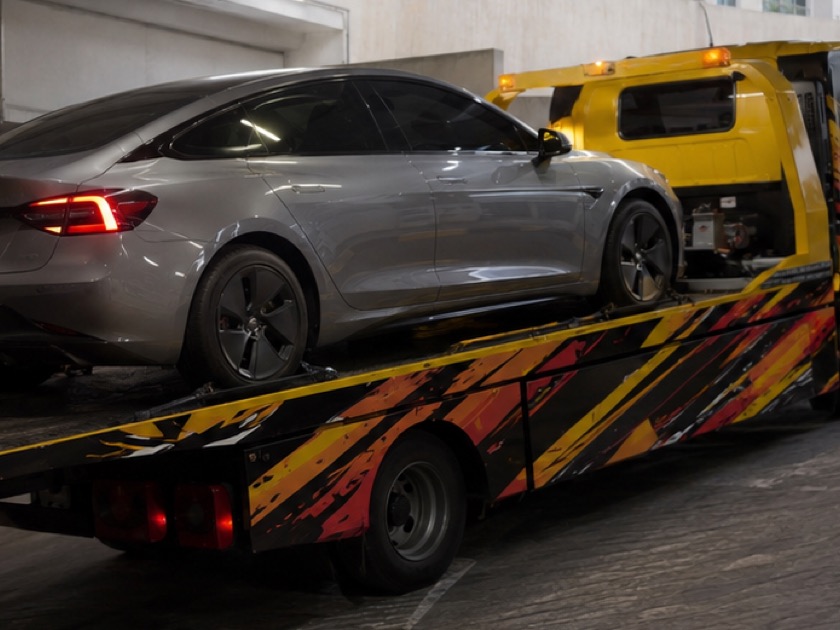
Why do the wheels matter? An automatic that will not go into neutral, an EV, and any car with a locked wheel all need to be lifted fully onto a flatbed. Give us that detail early and the right unit is sent the first time. Motorcycle towing works the same way — a bike travels strapped down on a dedicated moto lori, never on a rope behind a car. For a lori or a commercial van, the unit is matched to tonnage: 5 tonne, 10 tonne or 15 tonne, so say what you are driving before anything moves.
Mention the destination too. The car goes to the workshop you choose — give us the name and location upfront so the full price is worked out in one go. If the breakdown is on a PLUS highway stretch far from home, interstate towing can be arranged as a single run rather than two.
Stranded right now? Send your live location, the vehicle type and the signs you saw in one message. Abang Tow is on standby 24 hours across all 13 states in the Peninsula — price is confirmed over WhatsApp first, then the tow truck moves.