Quick Answer: Roadside Assistance vs Car Towing
These two services get mixed up constantly, and that is exactly why so many drivers end up paying twice for one breakdown.
Roadside assistance solves a small problem right where the vehicle stopped, so it can move again under its own power. A crew turns up with tools, does a quick job, and you carry on with your trip.
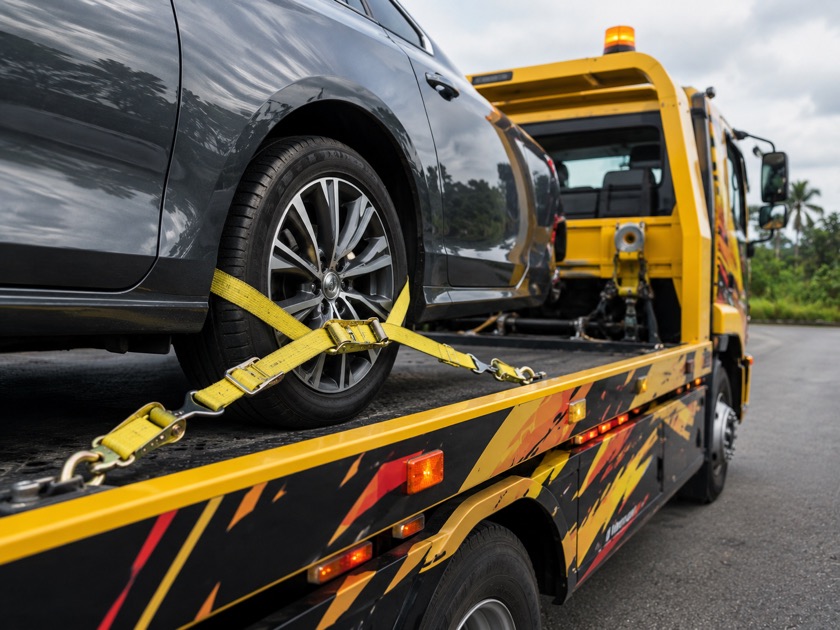
Towing accepts the plain truth that the car is not going anywhere by itself today. The vehicle goes up onto a truck and gets delivered to whichever destination you name.
The simplest test: can this be solved with one small part or one simple action at the side of the road? If yes, that is a roadside assistance job. If the answer involves the engine, the gearbox, the brakes or a wheel — get ready for the truck.
- Roadside assistance: the car recovers on the spot and you drive yourself to your destination
- Towing: the vehicle is carried, and you arrange your own onward transport
- Choose wrong: you pay the crew who came out, then pay for the truck as well
Comparison Table: Roadside Assistance and a Towing Service Side by Side
These are the six factors that actually decide the call you make at the roadside. Read across the rows, not just down the price column.
- Type of fault — Roadside assistance: one small component has failed, or one supply has run out. Towing: one of the vehicle’s main systems has gone.
- End result — Roadside assistance: the car runs again and can be driven. Towing: the car reaches your destination safely, but still cannot be driven.
- Workshop needed — Roadside assistance: usually no workshop visit the same day. Towing: the workshop is the destination.
- Risk of choosing wrong — Try to patch a serious fault at the roadside: the damage spreads and the repair bill climbs. Carry away a minor one: you pay truck money for a flat battery.
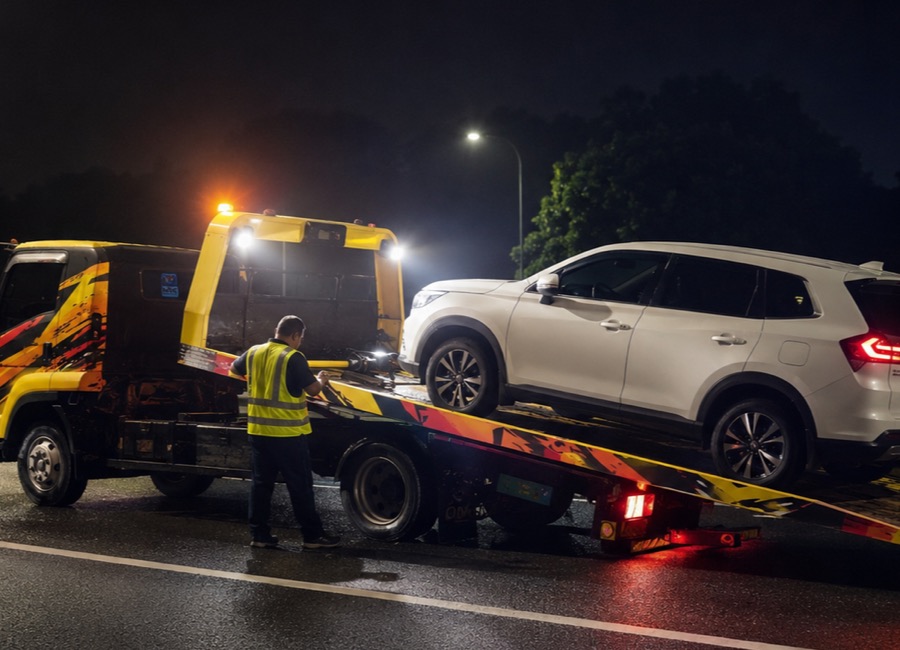
- How it holds up at night — Roadside assistance: useful for small faults, but with workshops closed any deeper check has to wait. Towing: runs as normal, the car is parked somewhere safe first, and workshop work starts in the morning.
- Cost structure — Roadside assistance: a call-out charge plus the cost of whatever part is replaced. Towing: worked out by distance for cars, and by tonnage for lori in the 5 tonne, 10 tonne and 15 tonne classes.
Faults Usually Sorted Out on the Spot Without a Tow Truck
Not every car that stops needs to be carried away. These four cases most often recover right where they are.
A flat battery tops the list. A jumpstart is usually enough to get the engine turning again. But keep one thing in mind: a jumpstart treats the symptom, not the cause. If the battery light stays on after the engine is running, the alternator is not charging — and the car will die again somewhere along the way.
A puncture is solved if the spare still holds air and the jack and wheel spanner are genuinely in the boot. If the spare itself is flat, or you lost two tyres at once to a pothole, that case turns into a towing job.
Running out of fuel is straightforward too — the crew brings enough to reach the nearest station. Keys locked inside depends on the model; cars with smart keys and modern immobilisers usually need the manufacturer rather than a bent wire.
If the engine gives you nothing at all when you turn the key, our list of reasons why your car will not start at all helps you work out whether this is a battery case or something more serious.
- Weak battery or a loose terminal — jumpstart, then get the charging system checked the same day
- A single puncture — swap to the spare if it holds air and the tools are complete
- Out of fuel — an emergency top-up delivered straight to your location
- Keys locked inside the car — depends on the locking system fitted
- Blown fuse or a terminal that has come off — small job, big effect
Cases That Still Need Flatbed Towing — Engine, Gearbox, Brakes, Accidents and Floods
Some faults cannot be repaired on the shoulder by anyone. In these cases, trying roadside assistance first is not saving money — it is adding to the bill.
A badly overheating engine, an oil pressure light glowing, or heavy knocking from inside the engine all mean the same thing: switch it off and leave it off. Every extra kilometre turns a moderate repair into a major one.
A gearbox that has jammed, gears that will not engage, or a loud whine with the car shuddering — that is workshop work, not roadside work. And an automatic that cannot be shifted into neutral has to be lifted fully onto a flatbed.
Brakes are not a cost question, they are a safety question. A pedal that sinks softly to the floor, or steering that suddenly goes heavy, means you have less control of the car than you think. That is a carry job, full stop.
After an accident, even when the car looks driveable, the chassis and wheel alignment may already be compromised. After a flood the rule is even simpler: do not start it. An engine that has swallowed water is wrecked on the first turn, not after a few kilometres.
Already clear that your case is on this list? WhatsApp Abang Tow — send your live location, the vehicle type and the symptoms in one message. The full price is confirmed in the chat first, then the unit moves.
- Overheating engine, lost oil pressure, or heavy knocking noises
- Jammed gearbox, gears that will not engage, or a fully failed transmission
- Soft brakes, brakes gone completely, or steering that suddenly turns heavy
- A locked wheel or a collapsed bearing — the wheel cannot turn freely
- After an accident, or after the vehicle has been submerged in a flood
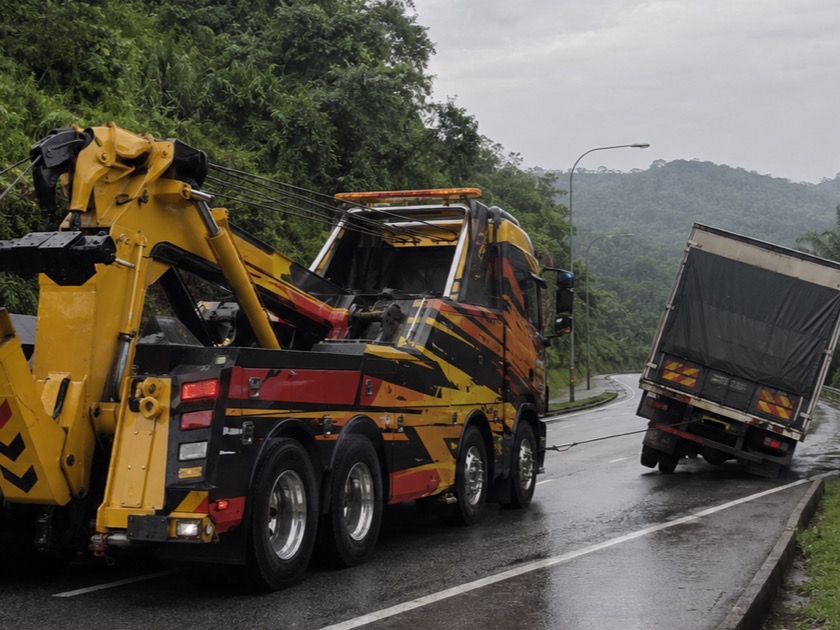
- A motorcycle that has gone down, and lori in the 5 tonne, 10 tonne or 15 tonne classes needing a heavy unit
When Trying Roadside Assistance First Genuinely Makes Sense Before Any Towing
Not every case has to go straight onto a truck. Four conditions make an attempt at the scene worth it.
First condition: the symptoms point to one obvious cause. A car that is dead after the interior lights were left on all night, or a tyre that went down after you ran over a nail — the cause is no mystery.
Second condition: the car stopped quietly, not after a loud bang, smoke or a burning smell. A vehicle that cuts out suddenly while making strange noises is rarely a small case.
Third condition: you still have an unused benefit. Plenty of motor insurance and takaful policies include roadside assistance within set limits, and automobile club memberships work the same way. If the cap is still there, use it first. Check the roadside assistance options available in Malaysia to see which doors you can knock on and the limits on each.
Fourth condition: you are somewhere safe and can wait calmly. If the car is stranded in the fast lane, on a blind bend, or on an unlit stretch with no shoulder, safety beats saving money. Getting to the next R&R or a lit lay-by is not always possible — in that case, do not wait around.
- A single, obvious cause — battery, tyre, fuel, keys
- The car stopped with no loud noise, smoke or burning smell
- Policy or membership benefit still has room left and the conditions fit your case
- A safe spot with a proper shoulder, where you can wait outside the vehicle
When to Call a 24 Hour Towing Service Straight Away So You Do Not Pay Twice
Paying twice happens like this: the roadside assistance crew arrives, takes a look, and then announces the car has to be carried after all. You have already paid the first call-out, and now the truck is on top of it.
To avoid that, run this seven-step assessment before you call anyone. Follow the order and do not skip steps.
- Step 1 — Stop safely: pull onto the shoulder, switch on the hazards, put out the warning triangle, and get everyone out behind the barrier
- Step 2 — Note the exact symptoms: what noise, what smell, which warning lights came on, and what happened just before the car stopped
- Step 3 — Test only two things: whether the interior lights come on, and whether the engine cranks or stays silent
- Step 4 — Check the wheels: make sure all four turn freely and none of them are locked
- Step 5 — Match it against the list above: if the symptoms fall under "still has to be carried", skip roadside assistance entirely
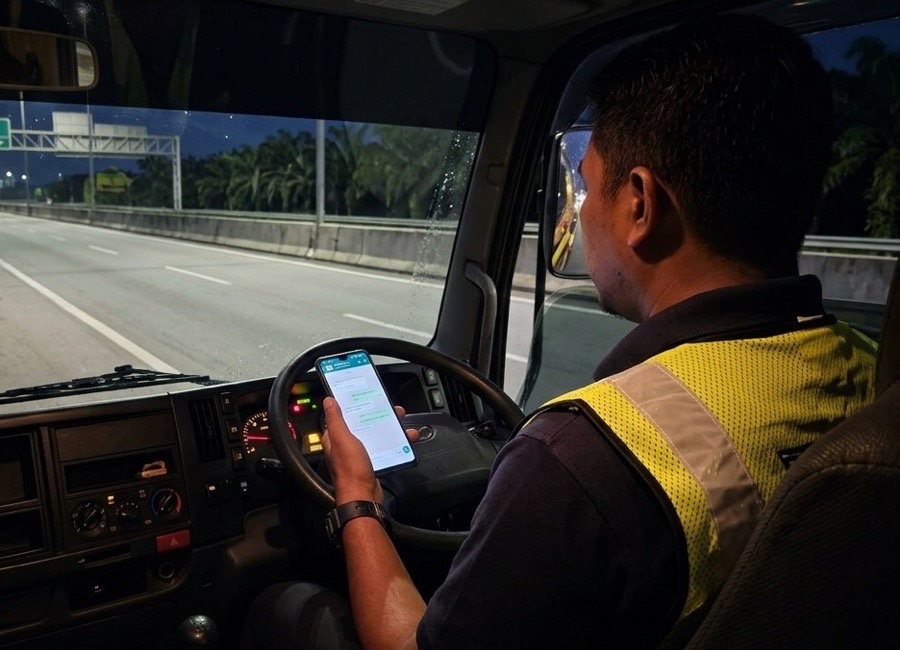
- Step 6 — WhatsApp your live location, the vehicle type and model, the symptoms and the destination you want — all in one message
- Step 7 — Confirm the full price in writing before the unit moves, and ask which unit is being sent: flatbed or wheel-lift
- Extra step — Photograph the car from every angle, including the odometer, before it goes up on the truck
The Verdict by Situation — Roadside Assistance, Car Towing, Motorcycle Towing or Lorry Towing
One more sign you should call the truck straight away: your destination is far from where the car stopped. Even if it fires up again, driving a long stretch with a fault no workshop has confirmed is a gamble — especially on the PLUS highway, where the next exit can be a long way off. For breakdowns around the busier Klang Valley routes, towing units in Selangor move all through the night.
The short conclusions, by situation, with no hedging:
- Battery, a single puncture, out of fuel, keys locked in — try roadside assistance first
- Engine, gearbox, brakes, steering, a locked wheel — carry it, do not waste time
- After an accident or after a flood — carry it, and do not start the engine
- An automatic that will not go into neutral, and any electric vehicle — flatbed only
- A motorcycle that has gone down, and lori or heavy vehicles — carry it, and state the tonnage early so the right unit is sent
- Middle of the night, a quiet spot, unclear symptoms — carry it, and let the car be checked calmly tomorrow
Car Towing Prices and Interstate Towing — WhatsApp Us Now
As a rough guide for cars, a move under 50 km starts from RM230, under 100 km from RM400, and under 150 km from RM450. For heavy vehicles the price is worked out by the 5 tonne, 10 tonne and 15 tonne classes. The final figure depends on the actual distance, the vehicle type and the condition of the wheels.
Stranded right now and still unsure which case is yours? WhatsApp Abang Tow — send your live location, the vehicle type and the symptoms. We confirm the price in the chat first, then the unit moves. No hidden charges.
We run a 24 hour towing service across Peninsular Malaysia — cars, motorcycles and lori, one number, day or night.