Stored Cars, Restoration Projects and Inherited Cars — When Car Towing Is the Right Call
Not every car that will not start is broken. Some of them have simply stopped moving.
These cases turn up in almost the same shape every time — a car left behind when the owner moved house, a restoration project that stalled halfway, or the late father’s car still sitting in the family garage.
The difference from a car that breaks down on the highway: a stored car is not going anywhere. What matters is lifting it without damaging whatever is still good — especially when the body is worth more than the engine.
The most expensive misunderstanding in these jobs is assuming the problem is just the battery. The battery is flat, yes. But it is only one of several things that have changed since the car last moved.
- Stored car — owner moved house, works overseas, or it is a second car that never gets driven.
- Restoration project — a classic bought to be fixed up, then parked halfway through the job.
- Inherited family car — a late relative’s vehicle that has to be moved when the house is cleared out.
- Newly bought car — the buyer knew it would not start and bought it that way.
What Goes Wrong Before the Tow Truck Arrives: Flat Tyres, Seized Brakes, Jammed Gear, Locked Steering
A car that has not moved in years does not have one problem. It has several at once, and every one of them makes the lift harder.
Flat tyres are the obvious one. The rubber goes hard, the sidewalls crack, and the section pressing on the floor develops a permanent flat spot. An old flat tyre can pop off the rim if you force the car to roll — and a bare rim sitting on cement gets badly scored.
Seized brakes are the ones most people miss. Pads bond themselves to the discs, and a handbrake left engaged can lock the drums completely. The result is wheels that will not turn at all, even with four people pushing.
Autos have their own version of this. With no electrical power the shift lock will not release, so the lever refuses to go into N and the transmission stays locked in P.
Locked steering rounds off the list. If the key is lost or the ignition barrel has rusted, the front wheels cannot be pointed anywhere, and a car that cannot be steered cannot be loaded the usual way.
One more reason not to experiment: cars in long storage often have rat nests in the engine bay and chewed wiring. Understand why the car will not start before you turn the key.
- Flat or cracked tyres — do not roll it, the rim gets scored and the tyre can come off the bead.
- Brakes or handbrake stuck on — wheels will not turn even when the car is pushed.
- Auto that will not go into N — the driven wheels cannot spin freely.
- Locked steering — the front wheels cannot be pointed while loading.
- Battery completely dead — not just weak, flat to nothing.
- Rat-chewed wiring or stale fuel — solid reasons not to crank the engine at all.
Why Flatbed Towing Uses Dollies, Skates and a Slow Winch — Not a Straight Pull Behind a Normal Tow Truck
If the wheels will not turn and the car gets dragged anyway, the outcome is not a mystery: tyres scrub until they tear, rims get deeply scored, hubs and bearings take load they were never designed for, and old suspension bushings can snap outright.
Dollies solve the locked-wheel problem. A pair of small rollers goes under the tyre that will not turn, so the car travels on the dolly wheels and the original tyres never rotate at all.
Skates — go-jacks, as most workshops call them — are for tight spaces. Each tyre sits on its own skate, so the car can be moved sideways instead of only forward and back. That is how a car comes out of a garage with a few inches of clearance on either side.
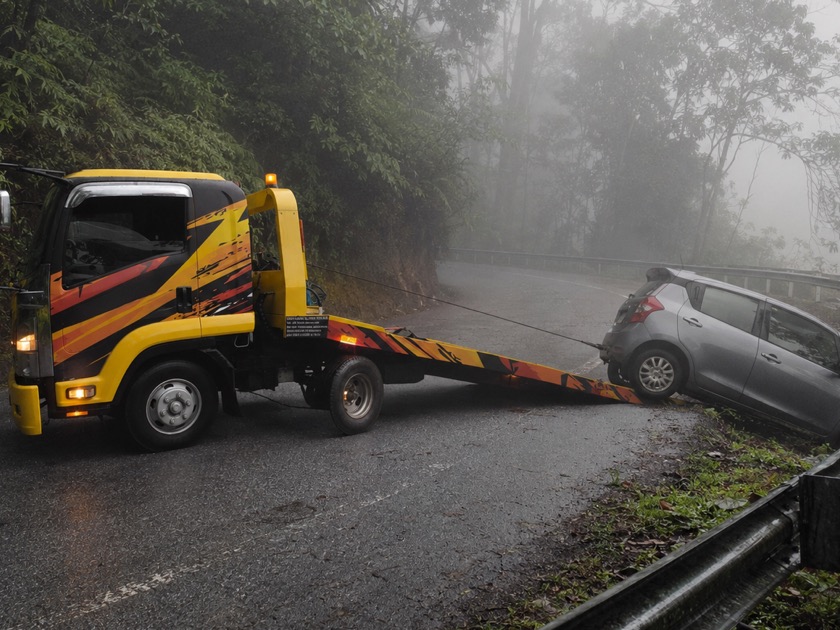
Winching is about control, not brute force. A car with no brakes and no steering has to go up the flatbed at a steady speed, with the cable hooked to a proper recovery point — not a rusted-through bumper. For a low classic, extra ramp boards go down first so the front apron and the exhaust do not catch.
The short version: a flatbed with every wheel off the ground is the correct method for old cars and for autos that will not go into neutral. If you are thinking of pulling it yourself with a rope, read the towing versus pulling it yourself comparison first.
- Dollies — when one or two wheels flatly refuse to rotate.
- Skates or go-jacks — when the car has to move sideways to get out of a tight garage.
- Slow winch — when the car has no brakes, no steering, or is sitting on a slope.
- Flatbed — the main method for old cars, autos and restoration projects.
- Extra ramp boards — for low cars, so the apron and exhaust do not catch on the way up.
Porch, Tight Garage and Soft Ground: Access Checks Before the 24 Hour Towing Service Arrives
This kind of job rarely happens by the roadside. It happens in a terrace house porch, in a back garage, or on unpaved ground behind a kampung house.
The real obstacle is usually not the car — it is the space around it. Gate width decides whether the unit can get in at all. Awning height decides whether the flatbed can be tilted where the car is standing.
Driveway angle matters too. A steeply sloping driveway can make the end of the flatbed scrape the cement, and a low car will belly out in the middle.
Soft ground is the risk most people overlook. Grass or red earth after rain will not carry the weight of a lori. In that case the car gets winched out to a paved surface first, using a long cable.
The fastest way to settle all of this: send three photos on WhatsApp. One from the road facing the entrance, one of the car and what is around it, one of the space behind the car.
Got the photos? WhatsApp Abang Tow — send your location, the access photos and the type of car. The price is confirmed in the chat first, then the unit moves. Standby 24 hours, across the whole Peninsula.
- Measure the gate width and the porch awning height — those two decide which unit gets sent.
- Check the driveway angle — a steep drop means extra ramp boards are needed.
- Grass or red earth after rain — say so early, so the car can be winched to the road first.
- Clear cars, motorcycles and pots out of the manoeuvring space.
- Check for low branches, cables and zinc roofing that would block the truck’s boom.
- Gated community or condominium — inform management so the lori is allowed in.
Where It Goes Next: Restoration Workshop, Storage or the Buyer’s House — Including Interstate Towing
Getting the car out of the garage is only half the job. The other half is making sure somebody is there to receive it at the other end.
If the destination is a restoration workshop, confirm two things: that the workshop accepts cars that will not start, and that it has space for a car that may sit there a while. Confirm the opening hours too — a car that arrives after closing ends up stranded outside the gate.
If the car has just been sold and is going to the buyer’s house, photograph the whole car before it goes up on the truck and again after it comes off. That small record settles a lot of disputes before they start.
Distance sets the price. A move under 50 km starts from RM230, under 100 km from RM400, and under 150 km from RM450. For deliveries across state lines, the interstate quote is given in WhatsApp based on the actual destination.
Stored cars are often far from the big towns — kampung houses, family land, old properties. Coverage runs across all 13 Peninsular states, including the rural areas handled by the Kedah tow truck unit.
- Confirm the workshop accepts cars that will not start and has somewhere to park it.
- Check the destination’s opening hours so the car is not left outside a locked gate.
- Make sure someone is at the destination to receive the car and sign off the delivery.
- Photograph the car before it goes up on the truck and after it comes off.
- Give the full destination address upfront so the distance quote is right the first time.
Owner’s Checklist Before the Car Towing Job Starts
Old-car jobs stall over paperwork and permissions far more often than over anything technical. Work through this list the day before, not on the day itself.
If the car is registered to someone who has passed away, or simply is not in your name, sort out written permission from the next of kin or the registered owner early — it is far easier to settle before the unit turns up.
- Step 1 — Find the car key. No key can still be worked around, but it has to be said upfront.
- Step 2 — Gather the documents: geran or a copy, the owner’s IC, proof of ownership.
- Step 3 — Get written permission if the car is not registered in your name.
- Step 4 — Inform the housing area or condominium management so the lori is allowed in.
- Step 5 — Clear the space around the car and make sure the exit route is not blocked.
- Step 6 — Take out every personal item and anything of value from inside the car.
- Step 7 — Photograph the car from all four corners as a record of its original condition.
- Step 8 — Confirm the destination address, who is receiving it, and when they will be there.
- Step 9 — Send all of that in one WhatsApp message.
Arrange Car, Motorcycle or Lorry Towing for a Stored Vehicle — 24 Hour Standby Across the Peninsula
A car that has been sitting for years does not get easier to move by waiting. Every monsoon season adds rust to the brakes, every month adds another crack to the tyres.
Stop trying to start the engine. A car that has not run in a long time belongs on a workshop ramp first — that is a job for a tow truck, not a set of jumper cables. The same goes for a project bike or an old lori parked in the same compound: motorcycle towing means the bike travels strapped down on a moto lori, and lorry towing is matched by tonnage — 5 tonne, 10 tonne or 15 tonne.
WhatsApp Abang Tow now. Send your location, the access photos, the vehicle type and the workshop it is going to. The price is confirmed in the chat first, then the unit moves — and the car is delivered to the workshop you chose, not the one we chose.